
Missouri Death Index
Missouri death index records are held by state and county offices throughout the state. The Missouri Bureau of Vital Records is the main source for certified death certificates, while the Missouri State Archives maintains a free online database of death certificates from 1910 through 1975 that anyone can search by name, county, and year. For deaths within the past 50 years, you must apply through the proper office and show a direct interest in the record. This guide covers every way to find Missouri death index records, who holds them, and what you need to get a copy.
Missouri Death Index Quick Facts
Missouri Death Index Primary Sources
Missouri maintains death index records through two main offices. The Missouri Department of Health and Senior Services Bureau of Vital Records holds death certificates from January 1, 1910, to the present. The Bureau is located at 930 Wildwood Drive, Jefferson City, MO 65109. You can reach them at 573-751-6387 during lobby hours, which run Monday through Friday from 9:00 AM to 3:00 PM. Appointments are recommended for in-person visits. Mail requests go to P.O. Box 570, Jefferson City, MO 65102. The Bureau holds both short form and long form death certificates, while county health departments typically carry only the short form.
The second key source is the Missouri State Archives. Under RSMo 193.225, death certificates more than 50 years old transfer from the Bureau to the Archives, where they become public records. The Archives provides free access through its online database and through in-person visits at the Research Room in Jefferson City. Staff will conduct limited research for patrons who cannot visit in person at no cost, permitting up to two requests at a time. Copy fees at the Archives are minimal, starting at $3.00 for the first five digital pages with additional pages at $0.25 each.
Local county health departments also serve as vital records offices for deaths that occurred from 1980 to the present. Each county office holds death certificates for events within its jurisdiction. Fees and hours vary by county, but most offices provide same-day service for walk-in requests. For deaths before 1980, the state office in Jefferson City or the Archives are the proper contacts depending on the year involved.
The Missouri Bureau of Vital Records can be reached by email at VitalRecordsInfo@health.mo.gov for questions about the application process, documentation requirements, and special situations. The Bureau typically responds within one to two business days. This contact is useful for questions about correcting errors on a death certificate, navigating international requests, and understanding apostille procedures.
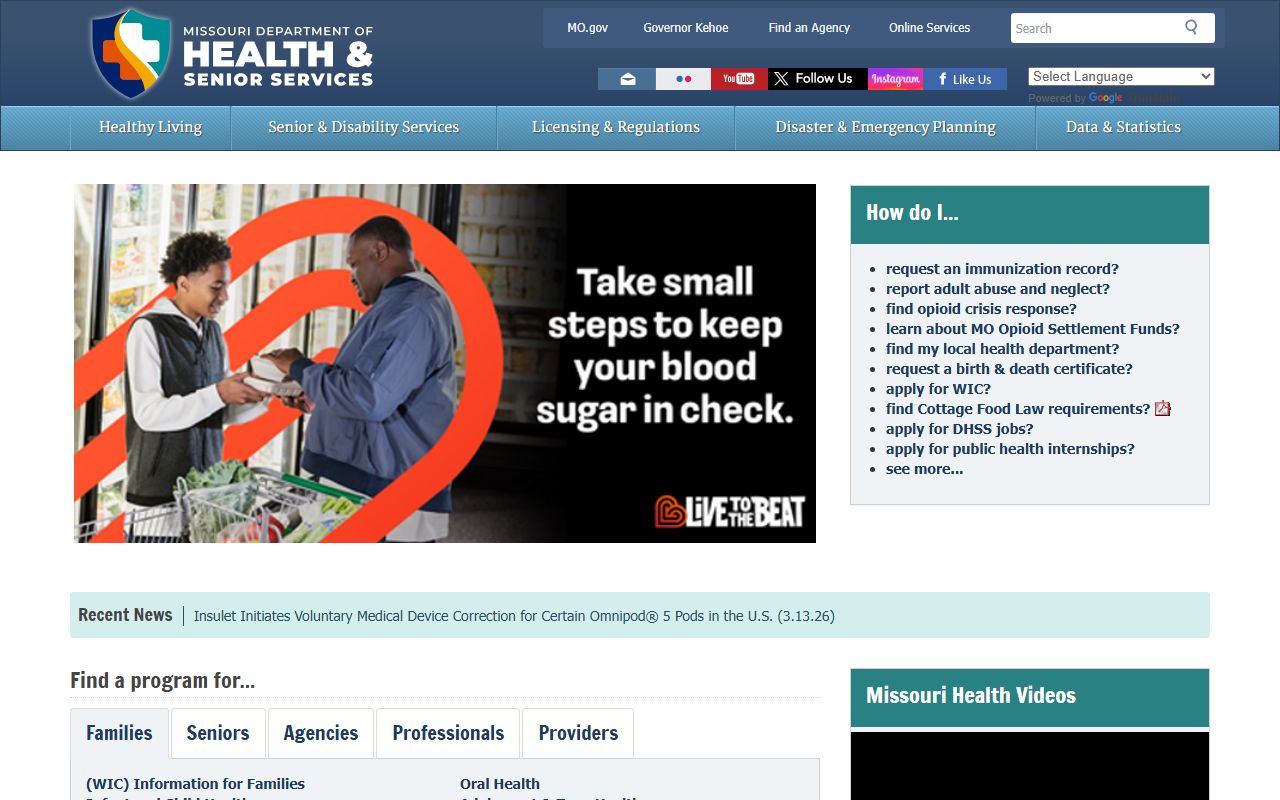
The Missouri Bureau of Vital Records ordering page shows the complete application process for obtaining a certified Missouri death certificate, including how to download the required form and where to submit it.
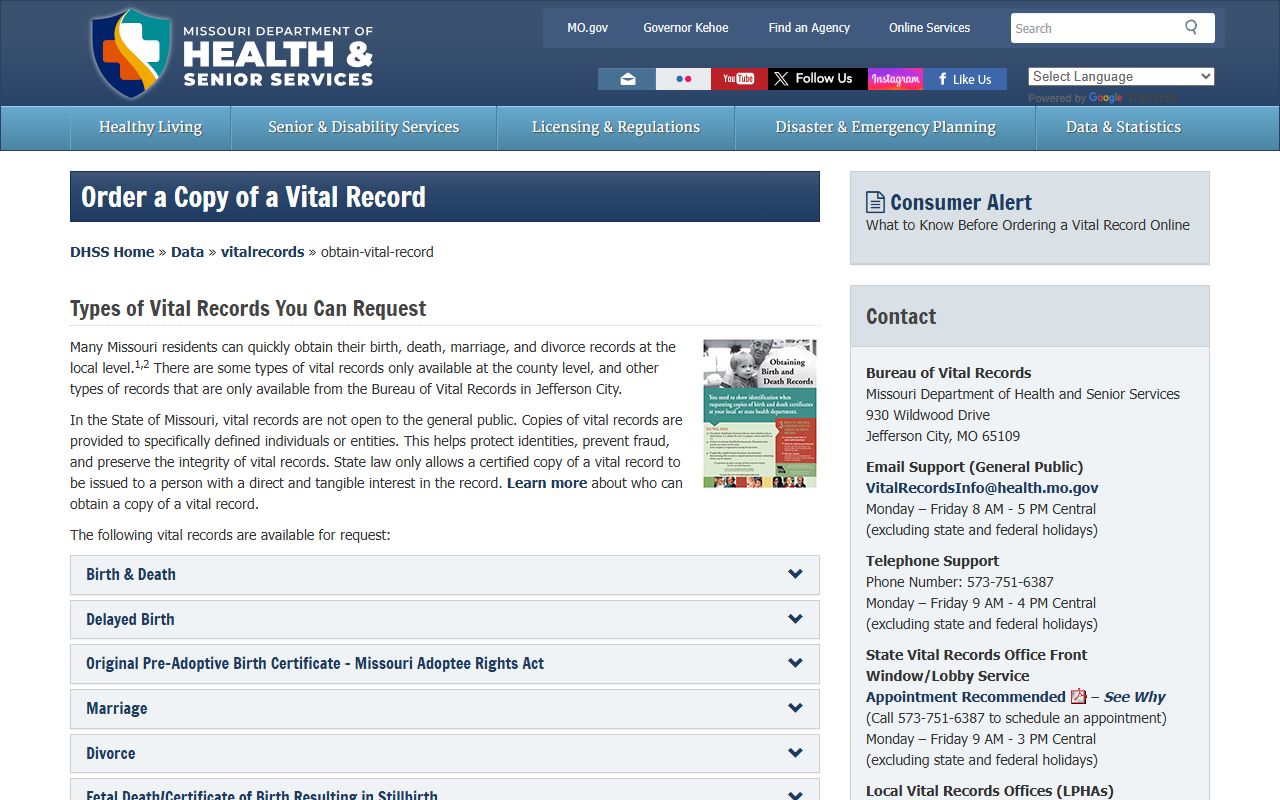
Use this page to download the Application for Missouri Vital Record or to learn how to place an order through the authorized online vendor.
Note: Checks sent to the Bureau of Vital Records are cashed upon receipt by a separate division. This does not mean your application has been processed or that a record has been located.
Missouri State Archives Death Certificate Database
The Missouri State Archives death certificate database is one of the most comprehensive publicly accessible death record collections in the country. The database contains more than 2.5 million digitized death certificates from 1910 through 1975, all searchable at no cost through the Archives Death Certificates portal. You can search by first name, last name, county, and year or month of death. Partial name searches work well when the exact spelling is uncertain. The database also supports Soundex code searches to find variant surname spellings.
For death certificates from 1954 through 1975, enhanced search options let you look up records by the name of the surviving spouse, the father, or the mother. This is especially useful for family history research when you know a relative's name but not the name of the deceased person. Each digitized certificate contains detailed information: the full name of the deceased, date and place of death, date and state of birth, both parents' names including the mother's maiden name, spouse's name, occupation, cause of death, attending physician information, funeral home name, burial location, and the name of the informant who provided the data. Family Tree Magazine has listed the Missouri State Archives among the top 101 family history research websites for many years running, and the death certificate database was searched nearly 28.5 million times in a single year, making it one of the most-used state archives collections in the United States.
The Archives also provides supporting tools on its website: a search tips page, a database of supporting conditions to help you interpret historical medical language, and a medical terminology dictionary. For questions, contact the Archives at archref@sos.mo.gov. The Research Room in Jefferson City is open to in-person visitors, and scheduling an appointment will help expedite your visit.
The Missouri Department of Health Bureau of Vital Records page provides full details on how the Bureau and the State Archives share custody of Missouri death records depending on how many years have passed since the death occurred.
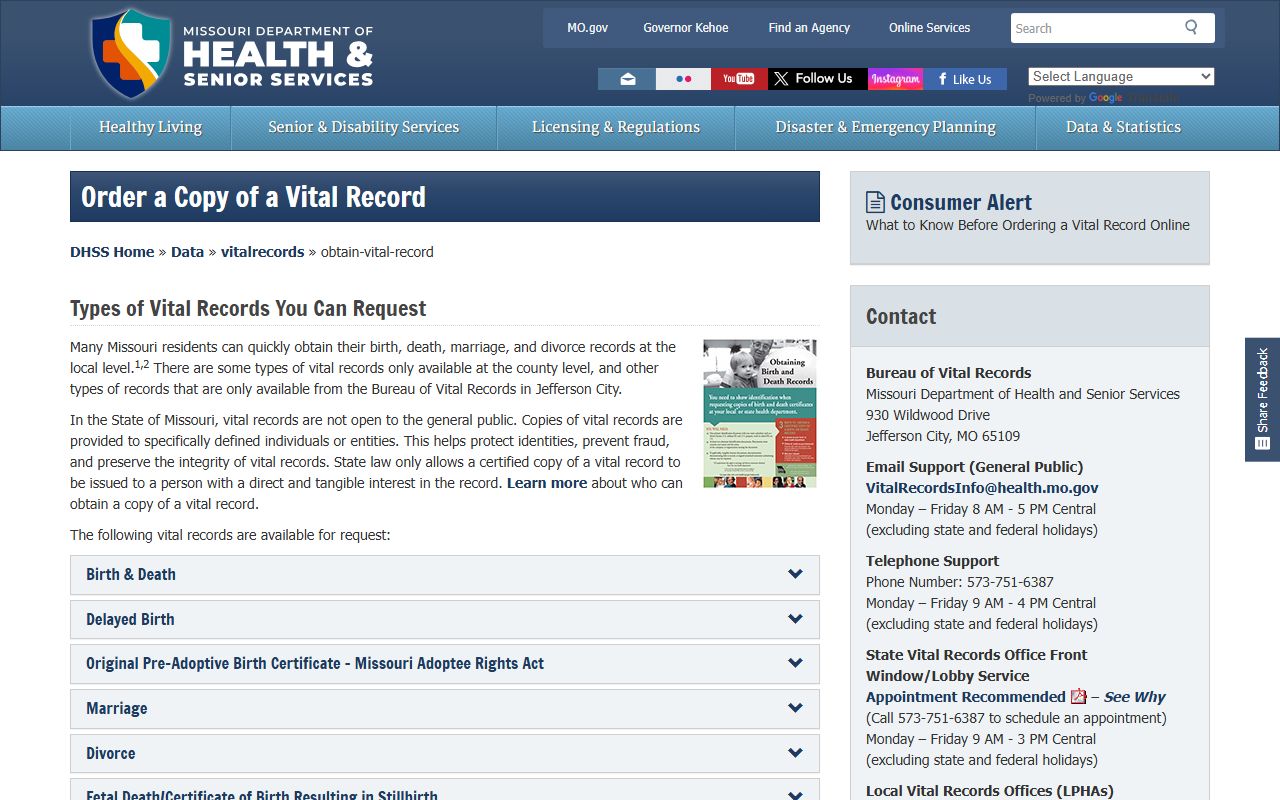
This page covers the division of records between the Bureau and the Archives, and explains how the 50-year confidentiality rule applies to accessing the Missouri death index.
How to Get a Missouri Death Certificate
There are three main ways to get a Missouri death certificate: in person, by mail, or online through VitalChek. The right method depends on how old the record is and how quickly you need it.
For in-person requests at a county health department, bring a completed Application for Missouri Vital Record, payment, and a valid photo ID. Acceptable primary IDs include a state driver's license, state ID card, U.S. military ID, U.S. passport, school ID, or work ID. If you do not have a photo ID, two alternate forms are accepted in its place. Alternate documents include letters from government agencies, W-2 forms, Social Security cards, court-certified adoption papers, deeds, vehicle titles, insurance policies, Medicare or Medicaid cards, payroll stubs, military discharge papers, cancelled checks, utility bills, and shelter name bands. Most county health departments print certificates within 10 to 15 minutes while you wait.
Mail requests must be notarized by a notary public. Send the notarized application along with payment by check or money order and a self-addressed stamped envelope to Missouri Department of Health and Senior Services, Bureau of Vital Records, 930 Wildwood Drive, Jefferson City, MO 65109. The fee under RSMo 193.265 is $14 for the first copy and $11 for each additional copy of the same record requested at the same time. That payment covers a five-year search window. If no record is found, the search automatically extends two years before and two years after the date you listed, meaning a total span of up to nine years can be searched without an additional fee.
The CDC Where to Write for Vital Records directory lists Missouri's vital records office alongside contact information for every U.S. state and territory, confirming the Bureau of Vital Records as Missouri's central repository for death certificate requests.
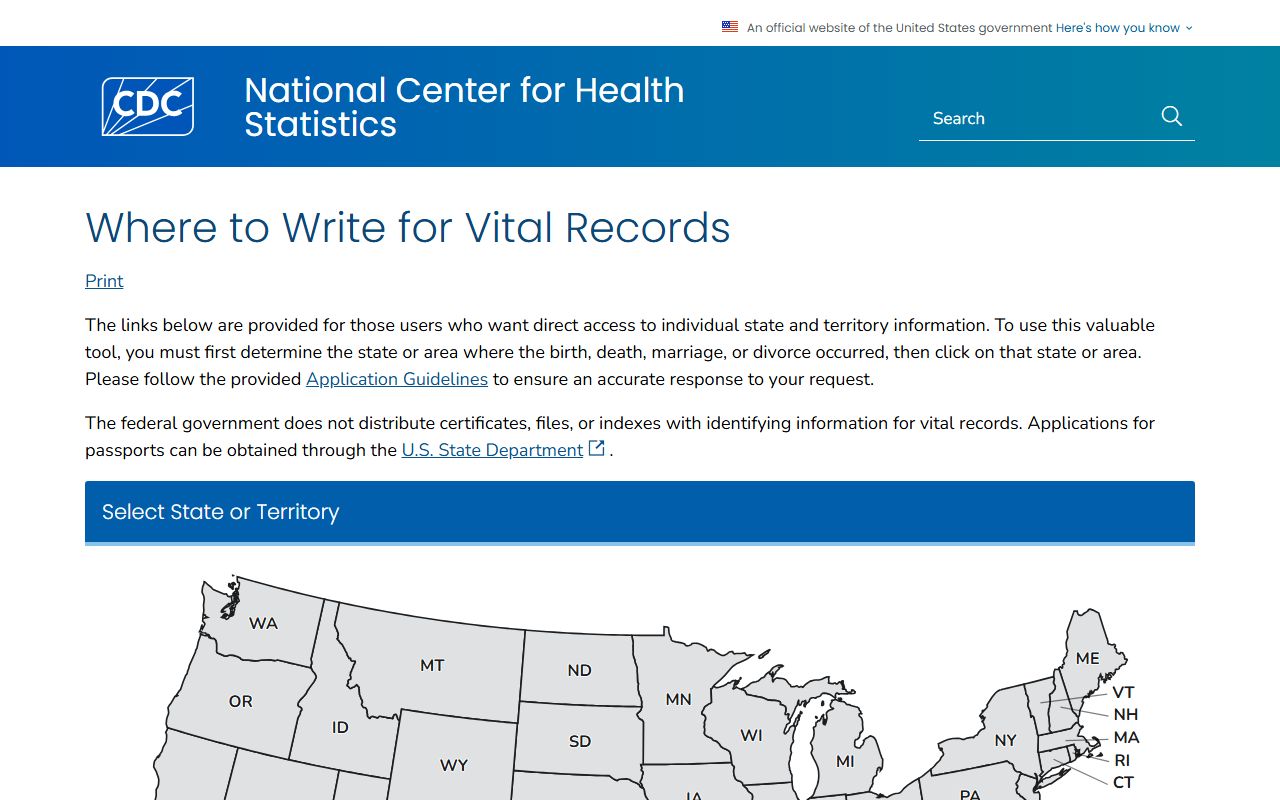
Use the CDC directory to compare Missouri's access requirements with those of other states, which is useful when a person died shortly after moving to or from Missouri.
Note: Mail requests sent directly to the Bureau typically take 4 to 8 weeks depending on volume. The VitalChek online service can reduce this to 3 to 5 business days.
What Missouri Death Records Contain
A Missouri death certificate holds a significant amount of personal and genealogical data. The standard short form certificate includes the decedent's full legal name, date and place of death, date and state of birth, sex, race, occupation, parents' full names including the mother's maiden name, name of surviving spouse, cause of death and contributing conditions, attending physician, funeral home details, burial location, and the name of the informant who provided the data. Long form certificates include additional medical certification language and fuller cause of death detail. The Bureau of Vital Records in Jefferson City is the only source for long form copies in Missouri, so if you specifically need the extended version, you must request it there and mark the long form checkbox on the application.
Missouri uses the Missouri Electronic Vital Records system, known as MoEVR, for electronic filing of all death certificates. Under RSMo 193.145, deaths must be filed electronically through this system by medical certifiers. The Bureau trains hospitals, funeral homes, and county health agencies on MoEVR through field representatives who travel the state and hold telephone or web conference sessions. Call 573-751-6387, option 4, for training requests or system access assistance.
Fields typically found in the Missouri death index include:
- Full legal name of the deceased at the time of death
- Date and county of death, with city or town if recorded
- Date and state of birth
- Father's full name and mother's maiden name
- Name of surviving spouse at time of death
- Occupation and industry
- Cause of death and contributing medical conditions
The Missouri Department of Health and Senior Services maintains general guidance about Missouri death index records on its public health portal, which also links to the downloadable application form and the online ordering system.
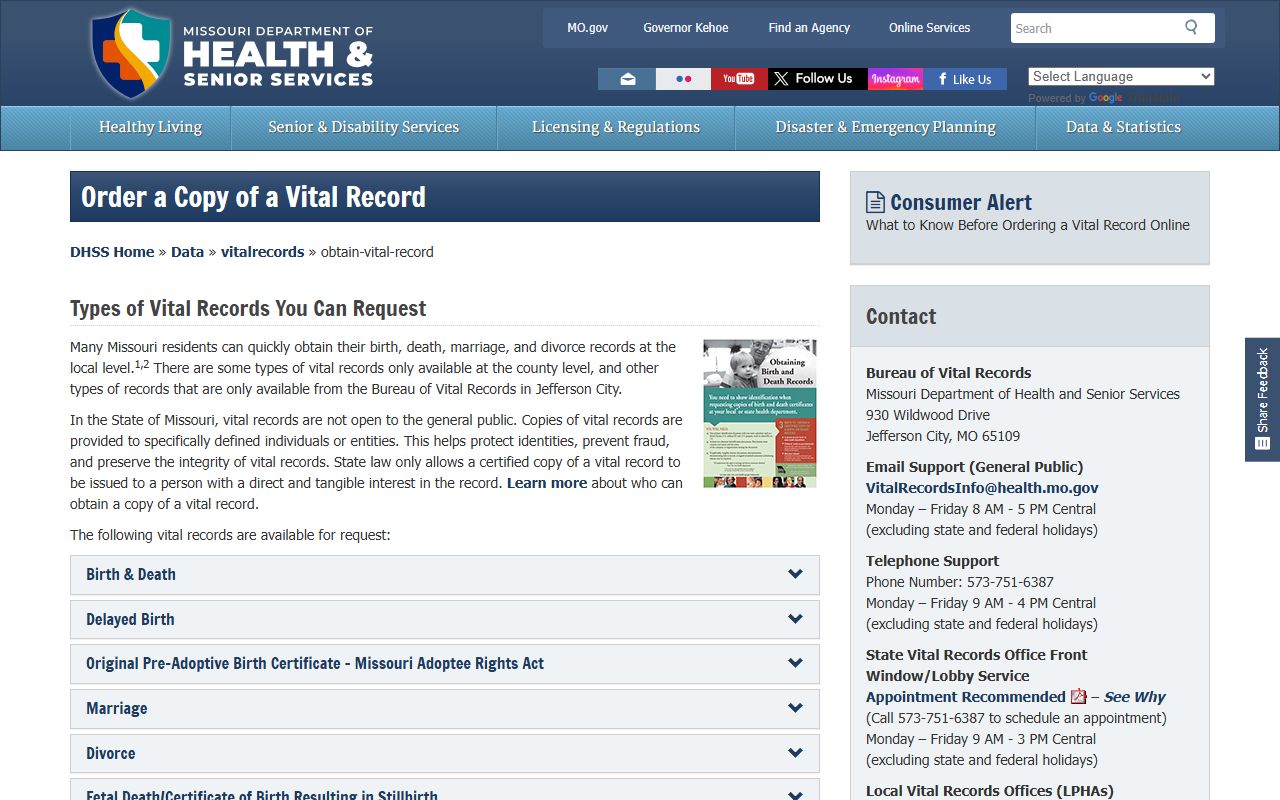
This page from the Missouri Department of Health covers the types of vital records maintained at the state level, including death certificates, and provides direct access to the vital records application materials.
Death Records Before 1910 in Missouri
Statewide death registration in Missouri began on January 1, 1910. Coverage before that date varies widely by county. Missouri passed its first vital records law in 1883, which authorized the State Board of Health to set up a registration system using standardized forms distributed by county clerks. But the law did not require reporting, and after a decade of poor compliance across most of the state, the General Assembly repealed those statutes in 1893. Death records from 1883 to 1893 exist for some counties but not others, and completeness ranges from fairly good in counties like Andrew, Buchanan, and Cape Girardeau to sparse or nonexistent in many rural areas.
The Missouri Birth and Death Records Database, Pre-1910 provides a free online index to microfilmed records from this early 1883 to 1893 period. You can search by name, county, and year range to find entries and then request copies of the originals. The Missouri State Archives also published a county-by-county guide showing which counties have surviving records and for exactly which years. That guide is available at the Archives vital records history page. The Archives holds over 250 reels of microfilm from the 1883 to 1893 period, with originals typically organized by county and year. Staff will conduct limited research for patrons and can copy records whether you visit in person or send a mail request.
For deaths before 1883, no state system existed. Researchers often find useful information in church records, family Bibles, cemetery transcriptions, military pension files, probate court records, circuit court estate files, and newspaper obituaries. The Missouri History Museum and the State Historical Society of Missouri both hold collections that may include early documentation of deaths in the state.
The Missouri Bureau of Vital Records email contact at VitalRecordsInfo@health.mo.gov can also redirect inquiries to the proper office when the right source for a particular record is unclear, which is especially helpful when dealing with deaths near the 1910 registration start date or near the 50-year public access cutoff.
Use the Bureau's email contact to ask about unusual situations, such as a death that may have been registered late or a certificate that does not appear in the expected database for the year listed.
Who Can Request Missouri Death Records
Missouri law restricts access to certified copies of recent death certificates. Under RSMo 193.255, only persons with a direct and tangible interest in a vital record may receive certified copies. This restriction protects the privacy of the people named in these records and helps prevent identity fraud. The Bureau of Vital Records, county health departments, and city vital records offices all apply this rule to deaths within the past 50 years.
Eligible requestors include the registrant if still living, a spouse, parents, children, siblings, grandparents, grandchildren, aunts, uncles, nieces, and nephews. Legal guardians with proper documentation, legal representatives acting on behalf of the family, funeral directors handling a current death, and individuals with documented property or legal interests also qualify. An attorney who can document that they are settling an estate or a beneficiary who can show they hold a deed of trust, for example, can establish tangible interest through supporting papers. Third parties who do not fit one of these categories must provide written documentation explaining their legal need before any office will issue a certified copy.
Death certificates more than 50 years old are public records and available at no charge through the Missouri State Archives database. Section RSMo 193.245 prohibits copying vital records for unauthorized persons, but this restriction applies only to records within the 50-year confidentiality window. Anyone can view and download older certificates from the Archives without providing a reason or showing a relationship to the deceased.
Missouri participates in the NAPHSIS Electronic Verification of Vital Events system, known as EVVE. This system allows authorized government agencies to verify the legitimacy of Missouri death certificates electronically without contacting the Bureau directly. EVVE is described as the sole source for immediate confirmation of death certificate authenticity. If an EVVE check fails, the requesting agency must write to the State Registrar at 930 Wildwood Drive, Jefferson City, MO 65109, explaining the failed attempt in detail.
Missouri's participation in NAPHSIS and the EVVE system means that agencies verifying a Missouri death certificate can do so electronically rather than waiting for a manual review, which speeds up the process for insurance claims, estate proceedings, and benefit applications.
Note: Adopted individuals born in Missouri may obtain vital records as if they were biological family members under state administrative policy.
Online and Phone Ordering for Missouri Death Records
VitalChek is the official authorized vendor for online and phone ordering of Missouri vital records. The Missouri Bureau of Vital Records contracts with VitalChek to process orders placed online or by calling toll-free 1-877-817-7363. The service runs 24 hours a day, 7 days a week. VitalChek verifies identity electronically through LexisNexis public record data, which removes the notarization requirement that applies to direct mail applications. This makes online ordering the most practical option for most people who need a Missouri death certificate quickly.
Standard processing through VitalChek takes 3 to 5 business days, with overnight delivery available for urgent requests. A service fee applies beyond the state's certificate fees, and costs vary by delivery speed and order complexity. For documents that need international authentication, VitalChek can route the certificate through the Missouri Secretary of State's office for apostille processing. Selecting "Apostille/Authentication" as the reason for your order starts this process automatically. VitalChek accepts all major credit cards, which is a practical advantage for those who cannot pay by check or money order for mail applications submitted directly to the state office.
VitalChek does not have direct access to vital records and cannot alter them in any way. The service acts only as an ordering and payment processing intermediary. All records are fulfilled by the Bureau of Vital Records in Jefferson City or by regionally approved vital records offices throughout the state. For requests requiring additional documentation beyond what VitalChek can verify electronically, the Bureau may contact the requestor directly to complete the application.
The VitalChek ordering portal for Missouri death certificates allows you to select the record type, provide identifying information about the deceased, and submit payment all in one step.
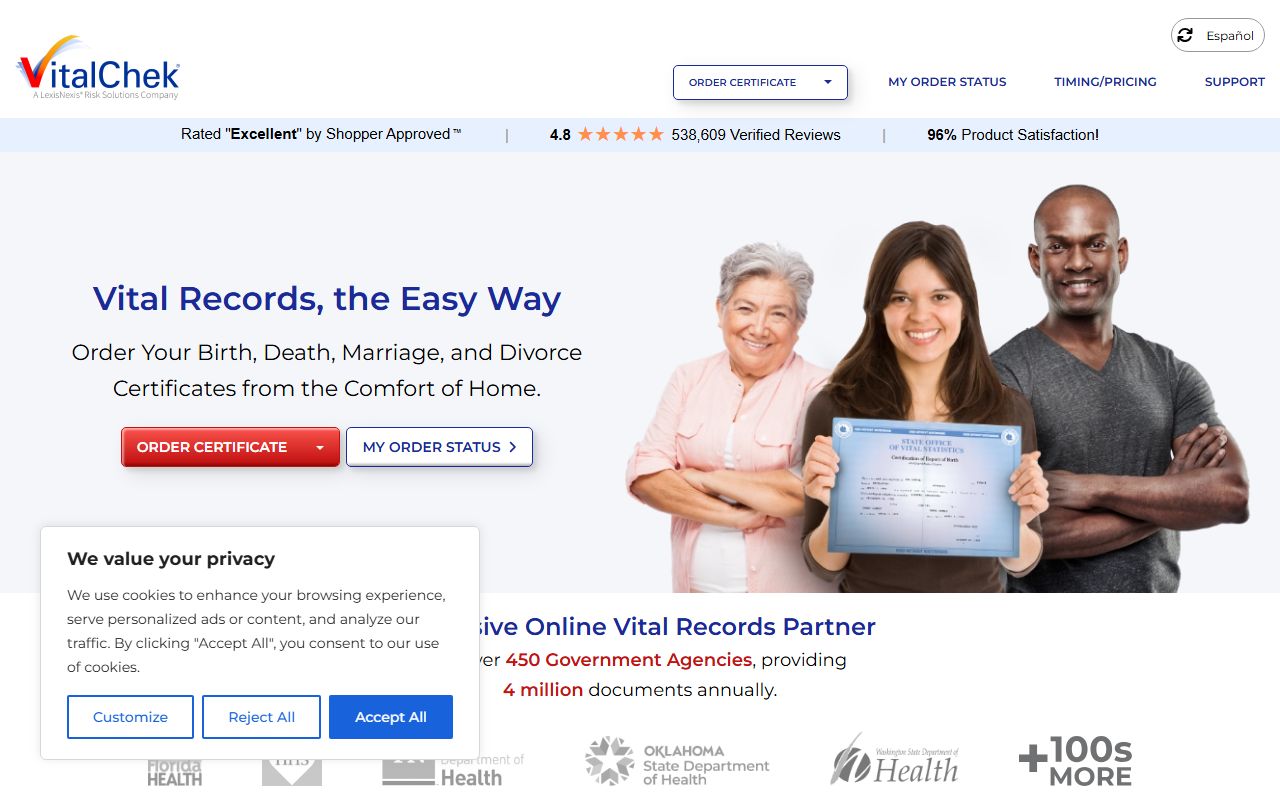
Use VitalChek when you need a Missouri death certificate faster than mail processing allows or when you want to avoid notarizing an application.
Browse Missouri Death Index by County
Each of Missouri's 114 counties maintains local vital records through its health department or county clerk's office. Select a county below to find contact information, local fees, and death record resources specific to that area.
View All 114 Missouri Counties
Missouri Death Index by City
Residents of major Missouri cities obtain death certificates through their county or city health department. Select a city below for local death record resources and office contact details.